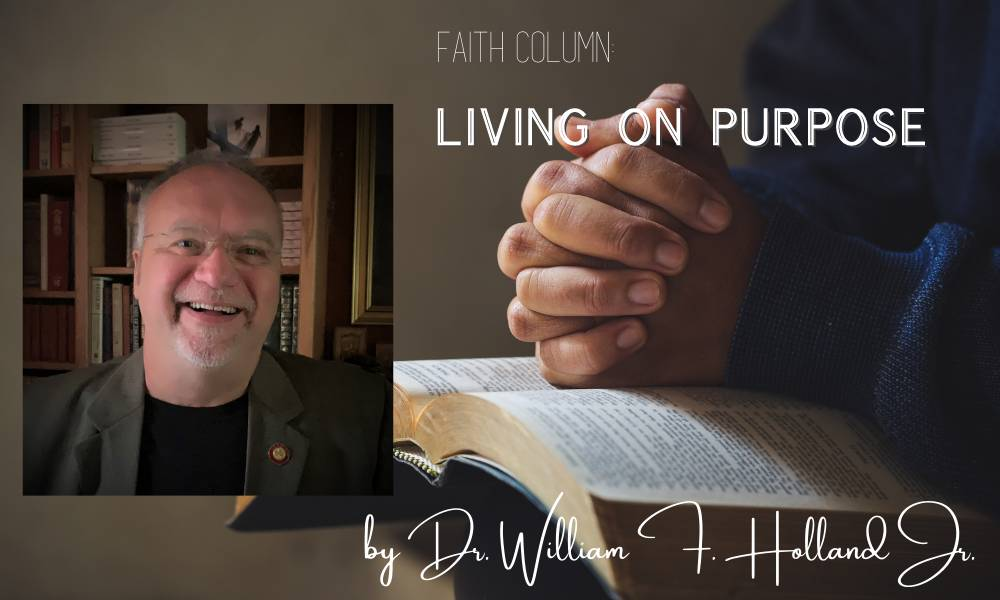
LIVING ON PURPOSE
Published 3/30/26
Crucifixion and Resurrection: Mission Accomplished!
April is the month of new beginnings when the grass turns green, trees begin to sprout their leaves, and flowers emerge from the ground to express their beauty. This is also the time when Christians celebrate the crucifixion and the resurrection of Jesus Christ. God’s infinite love for us is the foundation of the Christian faith, for without Jesus being raised to conquer death, hell, and the grave, there would be no sacrifice sufficient to forgive us from our sins. You see, His perfect blood was sprinkled on the mercy seat of Heaven and was the only payment that was holy and powerful enough to save the spirits of those who believe. John 19:30 declares the Son of God cried from the cross, “It is finished,” which guaranteed the covenant authority of God’s word as the greatest hope the world can ever know. Eternal salvation is now available for all who hear the gospel, are convicted to repent, and choose to embrace Him by faith as their Lord.
The gospel is known as the good news, a life-changing promise of forgiveness the world desperately needs. Like many of you, I have dedicated my life to sharing this gospel, believing it to be the power leading to salvation for all who accept it. What is this gospel? It centers on the precious blood that Jesus freely gave when He endured suffering and died on our behalf. After three days in the tomb, He rose, inaugurating the covenant of our salvation as part of God’s plan to ransom, redeem, transform, and restore all who commit themselves to Him. The Bible records the most profound love story, and many of you know the verses in Matthew 28:5-6 where angels greet the women at the empty tomb: “The angel said to the women, Do not be afraid, for I know you are seeking Jesus, who was crucified. He is not here, for He is risen as He said! Come, see the place where He lay.”
It’s required within our great commission to relay the good news, to emphasize the glorious significance of what His sacrifice and resurrection accomplished, what it guarantees for those who believe, and how we can have a blessed assurance of these glorious promises today. I personally do not use the word Easter as it is widely accepted to originate from the Anglo-Saxon spring goddess Eostre. In Scandinavia, she was called Ostra, and in Germania, Eastre. Others link it to Astarte, the Phoenician fertility goddess, who was idolized as the Babylonian counterpart Ishtar. Rabbits and eggs are symbols of fertility and were the theme of many ancient European and Middle Eastern festivals, including Persian, Egyptian, and Druid cultures, often accompanied by the wearing of new clothing to greet the goddess of spring. Sunrise services celebrated the vernal equinox by worshiping the sun and its great power, and there is so much more. So, why in the world would we who worship the majesty of Christ celebrate the traditions of pagan festivals?
According to Funk & Wagnalls Standard Dictionary of Folklore, Mythology and Legend, “The hunt for Easter eggs, supposedly brought by the Easter rabbit, is not mere child’s play, but the vestige of a fertility rite and the blessings associated with procreating. Some cultures believed that the decorated Easter egg “could magically bring happiness, prosperity, health, and protection.” All Christians should research holidays like Easter, Christmas, and Halloween to understand what they are really about. For Messianic Jews, the First Fruits (Bikkurim) feast falls within the Passover season, specifically the day after the Sabbath following Passover, which corresponds to the timing of the resurrection.
Holy week is about what happened to the Lamb of God and how it pertains to mankind. He is risen! Our greatest enemy, death, has been conquered! Our sins can be forgiven, and we can become born-again as God’s children! Let us rejoice and praise Him for His endless love and mercy! Ephesians 1:18-21. “I pray that the eyes of your heart may be enlightened so that you may know the hope to which he has called you, the riches of his glorious inheritance in his holy people, and his incomparably great power for us who believe. That power is the same as the mighty strength he exerted when he raised Christ from the dead and seated him at his right hand in the heavenly realms, far above all rule and authority, power and dominion, and every name that is invoked, not only in the present age but also in the one to come.”
Dr. Holland is an ordained minister, chaplain, teacher, and author. Read more about the Christian life at Billyhollandministries.com.
LIVING ON PURPOSE
Published 3/23/26
Learning about God and who we are in Him
How many times will it need to be declared that we can have as much of God as we want? And how many tears will we shed from the sadness of knowing that most people only want enough to get by? Having a serious spiritual relationship with God is difficult, as it takes a high level of desire and discipline on our part. If we are not passionate about developing a constant awareness of His presence, our emotions have a tendency to slide into an easier routine of just calling on Him when we need something. Having a covenant bond based on only what He can give us is not what He had in mind.
Since God is not tangibly visible and does not talk to us audibly, we are left to our own diligence and responsibility to bond with Him by faith. Yes, we become stronger the more we make time to know Him. Do you take the time to get away with Him every day, to share your heart, and tell Him how much you love and trust Him? We are familiar with our Thanksgiving holiday, where we spend the day thinking about our blessings and telling Him how much we appreciate all that He does for us, but the truth is that every day we should express our love and worship to Him, even when we are going through a hard time. We desire to hear about how much He loves us and wants to bless us, but if we only love and praise Him when things are going well, what kind of a relationship is this?
When we neglect knowing God, we are missing the beauty and fullness of loving Him. Some are convinced that if they attend church, this is their way of proving they know and love Him. However, in reality, just shaking hands, singing songs, and listening to a devotion is not the same as learning how to fellowship with Him daily. Do not misunderstand me, going to church is wonderful, but it does not take the place of living in the constant awareness of God’s presence. Advancing in our faith and progressing in our personal relationship with Him comes from reading, studying, worshiping, growing in our discernment, and praying. Only attending an assembly without pursuing Him in the secret place of the Most High is just settling for religious traditions. You see, reaching the higher levels of spiritual maturity will not just happen automatically; it requires us to draw nearer to Him.
According to the definition of conditional love, it’s an affection and attachment dependent on specific behaviors, achievements, or conditions being met. It is “earned” love, often taking the form of “I’ll love you if”, and it can be withdrawn or withheld if expectations are not met. This creates a high-pressure, insecure environment, often leading to people-pleasing, emotional invalidation, and anxiety. An example would be I’ll love you if you do this for me, or buy this for me, and if you do not do it, I will be offended and upset with you. This is a common dynamic in our earthly relationships, but when it comes to God, we are not to have a “Magic Genie” love that is conditional on what we want Him to do for us. Conditional love is often contrasted with unconditional love, which is given freely, regardless of circumstances.
It’s true we do not always understand why things happen, but this is why it’s important to draw as close to God as we can, so that even in the midst of difficult circumstances, we can rest in our faith in knowing that He will always love us. This life is only temporary, and our highest honor is to trust our Creator. In Jeremiah 33:3, the Lord invites us to seek His face regardless of our emotional state. “Call unto Me, and I will answer thee, and show you great and mighty things which you have never known.” It’s worth considering that neglecting to be bonded with Jesus could be the reason why many people are anxious and fearful about their lives and the life to come. Allow the love and joy of the Lord to lift you up today, and remember that God has always loved you and is longing to spend the rest of eternity with you. We are a work in progress, and our lives are to be a daily classroom dedicated to learning who God is and who we are in Him.
Dr. Holland is an ordained minister, certified chaplain, author, and teacher. Read more about the Christian life at billyhollandministries.com.
LIVING ON PURPOSE
Published 3/16/26
Age is not an excuse for being unhealthy.
This might be one of the most unpopular articles of all time, but as I sit here wanting to express from my heart, my private burdens are being exposed. I care about you (and me), it’s the only reason I would write about such a challenging subject. I believe it’s better to step forward and deal with personal issues that are causing great harm to our bodies and our self-esteem. Excess body fat is a serious problem. Many people, including myself, tend to gain size and bulk around the waist. I do not like it, but within my mind, trying to do something about it is like climbing a vertical cliff. Most of the time, I talk myself out of trying even before I can gather the ropes and climbing gear.
Let’s face it, being overweight makes a person sluggish, and to be blunt, we do not like how we look. Our obesity can be a psychological dark cloud that hangs over us, along with being self-conscious of how we look when we get dressed or undressed, and anywhere that has a mirror. Not only are we seen by everyone, but we also feel bad for our spouse and how we have let ourselves go, as if our appearance were not important. I know those who love us say they do not care about our outward appearance, but what are they supposed to say?
I’ve heard people joke around about their appearance by saying things like, “I don’t care what people think, I just want to enjoy my life” or, “I’m too old to care anymore, I just want to be happy.” I get it, but are we really content and proud with what we have created? These types of comments evolve from the combination of secret frustrations and anger. Frustrating because of how difficult it is to break free from this powerful bondage, and anger for allowing ourselves to get into this mess in the first place. My intention is not to heap more condemnation or guilt on us, but to come out in the open and ask why we are stuck in this merry-go-round of being overweight and out of shape, and how we can stop yielding to the temptations to please and serve our flesh. I guess the big question is, do we believe this is a serious problem, or will we continue being controlled and living in denial? It is said that when we don’t deal with what’s going on, it keeps going on.
Within the context of being a marshmallow, the more bad foods we eat, the more we help diabetes take control of our destiny. Even when we realize that what we consume is the problem, some still refuse to change their lifestyles. They are discouraged and depressed, yet the desire to eat unhealthy is stronger than the desire to cast down these food addictions. Max Dupree is quoted, “We cannot become what we want by remaining what we are.” We are told that highs and lows from glucose and insulin can make us feel weird, which is why so many of us are on meds to keep us balanced. I realize I’m older, but I believe my cravings for afternoon naps are a consequence of my sugary diet and lack of exercise.
Exercise is a popular subject to talk about, but it’s very difficult to actually do. Personally, I’ve had visions of working out, but have never been serious about it. I have every opportunity to do push-ups and sit-ups, but I don’t want to. I would much rather sit down and watch something meaningless. Just how important is this to me? Yes, I’m old and tired, and I do not have the energy I once had, which proves even more how I must accept that I’m responsible for my health. What about embracing our bad habits, eating too much, eating the wrong types of food, not getting enough cardio exercise (which causes us to not only be out of shape, and the reason for our muscle atrophy), retaining fluid, heart-artery, lung, kidney, liver, and pancreas problems, and this is just naming a few. I can make a lot of excuses about my negative addictions, but the pain has not yet caused me to raise my game. We can continue to ignore our old attitudes, or we can become motivated to be transformed into the best version of ourselves. Isn’t it better to be honest, even if it hurts our feelings?
Dr. Holland is an ordained minister, chaplain, author, and teacher. Read more about the Christian life at billyhollandministries.com
LIVING ON PURPOSE
Published 3/9/26
Standing strong with confidence in God
Fear and anxiety are negative byproducts of modern life, trying to influence us away from God. Our jobs are often stressful, our relationships and finances, and even our children struggle with social pressures we hardly faced when we were their age. Some people turn to natural remedies, like the newly popular cannabidiol products, while others are absorbed in social media, but there is even better news that can give us peace in this troubled world. The Bible remains an unfailing source of hope and comfort in the seasons when we are discouraged and perplexed. Psalm 46:1-3 declares that even in the darkest times, we can stand strong in the light of God’s authority because we are trusting that His promises are true. “God is our refuge and strength, an ever-present help in trouble. Therefore, we will not fear, though the earth give way and the mountains fall into the heart of the sea, though its waters roar and foam and the mountains quake with their surging.”
There are times when all of us, at one time or another, feel sad and discouraged. It’s alright to occasionally examine our situation, but we should not pitch our tent and decide to live there. It’s the irritating things that can distract us and start pulling us toward doubt and worry. Changing our mind can change our attitude, but it does not just happen all by itself; it takes having a strong desire to transform our mind, which involves choosing the type of life we want to live. We know that spiritual faith is being positive-minded, which gives us joy and strength, and we can also establish that optimism is the key ingredient for happiness. It helps us live more fully and engage more generously with life. It helps us notice joy, to see what is possible, and take the next steps with hope and confidence. In my office, my desk is covered with encouraging quotes that remind me to stay positive and focused on God – He is the way, the life, and the truth.
For many, their wealth and health are their security, and they cannot fathom the thought of losing them. However, may we remember that God is our ultimate security and our healer. Though His followers live in this world, we are also citizens of heaven. What an encouragement to know this temporary life is not all there is – our future is forever! “He shall cover you with His feathers, and under His wings you shall take refuge; His truth shall be your shield and buckler. You shall not be afraid of the terror by night, nor of the arrow that flies by day, nor of the pestilence that walks in darkness, nor of the destruction that lays waste at noonday.” When we are overwhelmed with fear and feel as if the walls are closing in on us, we can know that God is with us and will always take care of us. Remember that faith nor fear force themselves upon us; they are invited guests. We are given the choice to select one of two foundations we will stand on; thus, yielding ourselves to God’s care must be a deliberate decision. We cannot always control what is happening in our surroundings, but we can control how we react to them.
When we truly believe that He is watching us even more closely than the tiny Sparrow, we will stop doubting His desire and ability to deliver and sustain us. God loves us and wants everyone to understand and believe that He is who He says He is. In John 14:27, Christ promises, “Peace I leave with you, my peace I give unto you: not as the world gives, give I unto you. Let not your heart be troubled, neither let it be afraid.” He is saying the world cannot give us the spiritual security that He offers because it’s only based on materialism. When Christ sits on the throne of our heart, we are no longer frantically trying to figure out our own solutions, but we can trust in His power and wisdom to bless and protect us. Optimism doesn’t change the world; it changes how we see the world. Since fear is a learned behavior, can we not train our minds to accept faith instead? When our will is to do His will, we will enjoy His peace that passes all understanding. “The Lord is my light and my salvation; whom shall I fear? The Lord is the stronghold of my life; of whom shall I be afraid?” Psalm 27:1.
Dr. Holland is an ordained minister, chaplain, author, and teacher. Read more about the Christian life at billyhollandministries.com
LIVING ON PURPOSE
Published 3/2/26
Who said that retiring is the end of our calling?
As days pass, we can complain about time flying or rejoice in our blessings. I never thought much about retirement when I was younger, but as the saying goes, it’s never too late to be what you might have been. Had anyone told me I’d teach in public schools later in life, I would have been surprised. Now, as a teacher, I can honestly say it’s the most exciting and satisfying profession I could have imagined. Teaching is a labor of love, and helping children with their education is among our highest priorities. Yes, at times the children test my patience, but most are kind and respectful. Jesus loves the little children, and I sense the seriousness of guiding tomorrow’s leaders, who will face even more challenges, as also being targeted by the enemy of our souls. It’s critical for us to lead by example, as we can help them understand right from wrong, and to know God and see His truth.
I believe it’s important as we grow older to stay active instead of just lying around. I realize that some older individuals have health issues and cannot do what they would like to do, but many are in decent shape, but just choose to do nothing. It seems the more a person gives in to their excuses of how they are tired from paying their dues, the worse they feel. Inactivity is alright when we are resting, but the more we get up and get going, the more energetic we are. I encourage everyone to find something that’s really important to you and see how you can help. I’ve heard it said that we must not live to work, but work to live. The achievement of your goal is achieved the moment you commit yourself to it, so no matter how old you feel, or how many times you’ve officially retired, it’s never too late to give the world a little more of what God has given to you. We should pray and ask for God’s inspiration, strength, and wisdom, but hopefully, a person will eventually discover that he or she is the master-gardener of their soul and the decision-maker of their destiny.
I was talking to an older teacher the other day during our planning period, and we chatted about how different the world is now from what it was when we were growing up. We touched on everything from the high cost of living and how much the education system has changed, to how a godless society has rearranged the culture, mostly for the worse. I agreed when she said we need good role models for these children, and how teachers are on the front line with the opportunity and responsibility to demonstrate a Christ-like character while planting positive seeds of hope and truth. It’s said that a teacher takes a hand, opens a mind, inspires a heart, and shapes the future, and I firmly agree that the influence of a good teacher can never be erased. Teachers do not teach because they need a job; they know it’s their life’s calling. I personally wanted to do something that could truly make a difference, as it’s true, teachers change the world – one child at a time. She concluded that we needed more Christian leaders involved with public education and thanked me for my efforts.
We went on with our day, going through the switch classes, and finally, at the end of my last class, there was a young man who stayed over a few minutes to pick up pencils and paper from the floor, and connect some of the Chromebooks in the charging cabinet. I was turning out the lights, and told him how much I appreciated him, and out of the quiet, he calmly asked if I knew Jesus Christ as my Lord and Savior. It was as if the lights had been turned on again. I was pleasantly humbled and impressed. I wondered how many 13-year-olds are being driven by their love for God and have the faith to share the gospel with their substitute teacher? I told him I was a minister and that I was proud and inspired by his spiritual enthusiasm and commitment to the Lord. As I was walking out to my car, I thought about the teacher who earlier had a burden for the young ones, and I knew she would be encouraged to know there are still good people and good kids in these trying times.
Dr. Holland is an ordained minister, chaplain, teacher, and author. Read more about the Christian life at billyhollandministries.com.
LIVING ON PURPOSE
Published 2/23/26
Whatever happened to the fear of sinning?
What does the average, or maybe we could say normal, person think about sin? Have you noticed that most people would rather listen to messages that talk about how much God loves us and wants to bless us, than how His heart is breaking over us failing Him? Some of you might be thinking, you thought this was an inspiring and encouraging column, but my response is like your mom used to say, before we eat our chocolate cake, we also need to eat our spinach. We claim we want to please God, but is this true? Our level of reverential fear of who He is reveals how much we love and respect Him.
Do we have an awareness or feel guilty when we are not displaying the character of God? For those who have made a vow to honor the covenant of Christ, are they convicted when they willingly disobey Him? One of the dangers of becoming distracted with the everyday activities of life is how seldom we examine our attitude and behavior. Being spiritually cold and calloused is how the heart and mind can grow numb to sin. Aren’t we required to develop spiritual discernment? It’s one thing to feel guilty about sins we commit, but we often forget about the sins of omission, where we neglect to obey His voice. We are deceived to assume that God is lenient about our rebellion, as He does not turn a blind eye to our secret games of denial.
This brings us to some interesting questions: Does God keep a running record of our sins? When we ask Him to become our Lord, does this mean all our sins, past, present, and future, are forgiven? If we need to constantly ask forgiveness, do we confess each sin specifically, or can we just take the easy way by grouping them all together as one general request? “Lord, forgive me of all my sins.” Some churches emphasize private confession, where the individual explains to the priest the ultimate details of what they have done. This particular theology believes a prescription is given that will eliminate the offenses from the eternal record. Other churches embrace that Jesus is the only personal mediator between God and man, and the only Savior who can forgive us. Jesus paid for our sins with His blood at Golgotha, but does this mean that all our trespasses are automatically washed away? Or are we required to repent for each specific sin? What if we forget about certain sins?
Sin is basically defined as missing the mark, which refers to God’s plan for the redeemed to live holy as He is holy. You see, God has the highest standard of purity and expects His people to see sin as intentional rebellion and disobedience. We have mentioned recently how it’s common for the average person to ignore sin as something that God does not pay attention to. This is not true. We need to realize our carnal behavior breaks His heart. When was the last time our sin made us physically ill to the point of being nauseated? Why are we not afraid of sinning against Him, especially since the Bible contains terrifying stories about those who did? One example is found in Joshua chapter seven about a man named Achan. He kept some of the valuable spoils of war, after God warned Israel to not keep anything, and his disobedience resulted in Israel losing the battle, the death of 36 soldiers, and he and his entire family were executed.
In Acts chapter five, we read about Ananias and Sapphira, a husband and wife who claimed to donate the full amount of a land sale to the church. However, as they secretly held back a portion for themselves, their deception was considered by God as lying to the Holy Spirit, and they fell dead. There is not enough room to list them, but consider just a few punishments for sin including Adam and Eve, the prophets of Baal, the flood, Miriam’s leprosy, Lot’s wife, Herod Agrippa, Nabal, Er and Onan, Uzzah, Nadab and Abihu, Sodom, the 250 followers of Korah, and the 42 children who mocked the prophet Elisha. The point is that just because we do not see people falling dead for their sins, this does not cancel the warning that declares the wages of sin are death. “Let us have grace, whereby we may serve God acceptably with reverence and godly fear: For our God is a consuming fire” Hebrews 12:28-29.
Dr. Holland is an ordained minister, chaplain, author, and teacher. Read more about the Christian life at billyhollandministries.com.
LIVING ON PURPOSE
Published 2/16/26
Do this in remembrance of me
Last week, we touched on the subject of baptism, and this week I thought we could follow up with a chat about communion. For those who are Christians, the church ordinance of communion is a sacred and spiritually personal event. In some circles, the Lord’s Supper is referred to as a sacrament, while others call it an ordinance, depending on the theological tradition. However, regardless of the term, within Christian churches, it is seen as a means of grace and an integral part of obedience and worship, established by Christ Himself. A time of sacred reflection on Christ’s death and resurrection. Where does it come from? It’s a recorded true event that is told in each of the four Gospels, along with the Apostle Paul, who also discusses it in 1 Corinthians 11:23-29. Verse 26 declares, “For whenever you eat this bread and drink this cup, you proclaim the Lord’s death until He comes.”
Most have seen the images of what is called the “Last Supper,” where Jesus and His disciples are sitting around a large table eating and drinking at what was called the Passover celebration. We read in all four gospels about this true account, and how Jesus wanted His followers to remember Him as the promised Lamb of God. In Luke 22:19-21, we read, “Jesus took a loaf of bread and gave thanks to God. As He broke it and gave it to His disciples, He said, this is my body given for you; do this in remembrance of me. In the same way, after the supper he took the cup, saying, this cup is the new covenant in my blood, which is shed for you.” Matthew 26:30 reveals that He concluded the meal by singing a hymn, then they walked out into the night to the Mount of Olives. As they entered the garden of Gethsemane, Jesus told them to rest while he took some time to pray. It was there that, as predicted, Jesus was betrayed by Judas. The following day, He was crucified.
Jesus declared that the bread spoke of His body that would be broken, as Psalm 22 and Isaiah 53 describe that He would be so brutally and violently tortured that it was hardly recognizable. The wine spoke of His blood, with Him indicating the terrible death He would soon experience. It is agreed that most likely He literally bled to death. Christ, the perfect Lamb, the Son of God, became the fulfillment of the countless Old Testament prophecies concerning a Redeemer. Genesis 3:15, often called the protoevangelium or first gospel, is an amazing biblical prophecy where God reveals that at the crucifixion, the serpent will bruise the heel of Jesus the seed of the woman, but in the resurrection, Christ the Son of God will crush the serpents head, establishing the Lord as the ultimate power and authority in the cosmic struggle between good and evil. In my view, the communion does not literally transform into the blood and flesh of Jesus, which is called transubstantiation. Since it is symbolic, I do see the point. It’s simply about keeping the sacrifice of His great love fresh within our hearts and minds.
So, as we partake of the unleavened bread and wine or grape juice, the elements serve as a covenant symbol of Christ’s body and blood, and how we grieve as He willingly suffered. He gave the supreme sacrifice of love that can redeem us. Now we can have spiritual hope and faith, as we celebrate this sign of unity and truth among believers, anticipating His return. I’ve served communion in churches, prisons, and correctional facilities throughout the years, and I currently work with a jail ministry preaching the gospel, baptizing, and serving communion, where I remind everyone how serious this is. First Corinthians chapter 11 says that whoever receives these elements unworthily will be guilty of sinning against the body and blood of the Lord. They absorbed damnation to themselves, and some have literally died. Never allow the ceremony to become a dead and formal ritual, or come to the Lord’s table with unconfessed sin. Personally, when I take the communion, I embrace this as entering into the holy presence of God. A time and place of repentance, asking forgiveness, being cleansed, and made presentable to become one with Him. I imagine Jesus hanging on the cross, and what great love that caused Him to willingly die to save me. It’s a personal moment of remembering and appreciating.
Dr. Holland is a licensed and ordained minister, a certified chaplain and teacher, and a Christian author. Read more about the Christian life at billyhollandministries.com.
LIVING ON PURPOSE
Published 2/9/26
Believer’s baptism or baptismal regeneration?
Believer’s baptism and baptismal regeneration represent two distinct views on the role of water baptism in salvation. Believer’s baptism holds that baptism is an outward, symbolic act of obedience performed “after” a person has consciously trusted in Jesus Christ and His blood for salvation. Conversely, baptismal regeneration teaches that baptism is the sacramental law where God creates spiritual rebirth, forgives sins, and initiates spiritual regeneration. While I tend to avoid writing about church doctrines due to disagreements, my ministry requires me to share my personal interpretations. I’m often asked about what washes away our sins, the water or the blood? There is power in His blood – not the water.
I share the gospel often, including in our local Detention Center on a regular basis. A place to teach and baptize is provided, and our team also serves communion to the new converts. This gives us an open opportunity to explain what it means to confess receiving Jesus as Lord and Savior. Sadly, not all Christians are united with church doctrines such as immersion versus sprinkling, infant baptism, and baptizing in the name of Jesus versus in the name of the Father, Son, and Holy Spirit, but even more importantly, there are different opinions about what exactly happens when the person goes under the water.
Some churches, including Roman Catholic, Eastern Orthodox, Lutheran, Churches of Christ, and some Anglican and Episcopal churches, including the Mormons, and Jehovah’s Witnesses, believe in what is called baptismal regeneration, which means a person is not cleansed from sin or spiritually transformed into a new creation in Christ until after they are baptized. Within these churches, baptism is referred to as a requirement that defines water as the only way to literally receive God’s grace, which saves. Groups such as Baptist, Church of God, Assembly of God, Reformed Presbyterian, Non-Denominational, Evangelical, Anabaptists, Mennonites, Quakers, Puritans, and The Salvation Army, use the term “ordinance” meaning that baptism although an important act of obedience, is only a public testimony symbolizing God’s power that has already forgiven and transformed the spirit’s of those who called upon the name of the Lord to save them, according to John 3:16.
As we are immersed under the water, this displays the spiritual reality of how we died to ourselves, were buried with Christ, and in coming up out of the water, we are raised from the dead by the glorious power of God to walk holy and obey Him in everything as His child. An outward sign of an inward work. Since we have been united with him in his death, we are also raised to life as He was. Yes, we are forgiven and washed clean by the blood of Jesus, as the power of sin is broken, and our carnality was crucified with Christ. As no longer slaves to sin, the new Christian is declared righteous through Jesus, but still has the free will responsibility to demonstrate His holy nature and character. We should consider ourselves to be dead to the control of sin and to have faith in God for everything. Take a moment to read Romans chapter 6. In fact, as we develop a solemn, reverential fear and awareness of His presence, sin should literally make us nauseated as we realize how much our disobedience hurts Him. If our intentional sins do not cause brokenness, weeping, and deep sorrow, we have become spiritually numb, calloused, and deceived. However, with God’s grace and mercy, our spiritual determination to deny our flesh and walk in sanctification can be rekindled by returning to our first love.
Baptism is not just a religious ritual. It’s a deeply personal commitment to living the life this holy re-enactment is revealing. It represents death to sin, the burial of our old life, and the resurrection to a new life in Christ! We are confessing and professing that Jesus is our Lord, and the miracle of being born again. We receive the gift of God’s love by declaring to the world that we are completely dedicated to loving and serving our Master. The believer’s baptism is an open display and promise that we will fulfill our vow to never return to who we once were. We now promise to allow God to lead us, we have become a temple of the Holy Spirit and are filled with the marvelous light of His eternal truth. Jesus died and resurrected so that you could become a member of His everlasting kingdom of peace and joy. Will you respond to His voice today?
Dr. Holland is an ordained minister, chaplain, and author. Read more about the Christian life at billyhollandministries.com.
LIVING ON PURPOSE
Published 2/2/2026
The Spiritual Battle For Our Attention
Let’s consider tracking how we spend our time in a typical 24-day period. Sleeping and working naturally take up most of it, followed by household tasks and hobbies, and finally, entertainment. Recently, I heard someone point out a troubling contrast: for Christians, spending more time on television or social media than on Bible study, prayer, or ministry seems out of balance. We often hear about the spiritual battle for our minds, but do our choices reflect the seriousness of this struggle? Though I’m involved with ministries and activities, I must ask myself whether I’m still allowing these daily distractions to consume too much of my focus. Do I believe there is such a thing as having a balance with my busy schedule of helping others versus how much time I spend watching and being conformed to the world? The essential question is whether our attention is fully turned toward God, or if we are trying to justify and play both sides as we indulge in meaningless distractions. Can you sense Jesus prompting you to re-examine your priorities?
Our grandson is a normal first grader who loves to play with Legos and all things related to Mario and Sonic. But he also has a strong connection to Minecraft computer games. He spends a lot of time on his switch, and becomes so deeply involved that it seems he loses contact with what’s going on around him. To even mention taking a break causes him to become upset. I was convicted about this the other day, and realized I would be the same way if someone took my television, computer, and cell phone away. Have we literally fallen in love with entertainment? Could this addiction be associated with a type of idol worship? The devices are not evil in themselves; they are just tools, but anything that captures our hearts receives our highest devotion. Romans 6:16 talks about the deception of slavery. “Do you not know that to whom you present yourselves slaves to obey, you become a slave to them, whether of sin leading to death, or of obedience leading to righteousness?”
I admit, I enjoy the internet, and browse as I relax and watch television, as I suppose most everyone else does. I have my phone with me at all times, as it’s now become a part of my life. I’m still astounded by the technology of a satellite beaming a video and audio signal to my big screen, and me having access on a handheld device that can produce information about anything I can imagine. Should we be concerned that Satan is the prince and power of the airwaves? Why am I not more obsessed with Colossians 3:1-2? “If then you have been raised with Christ, seek the things that are above, where Christ is, seated at the right hand of God. Set your minds on things that are above, not on things that are on earth.” Is it not disturbing that we have become obsessed with our technology devices? Are we being distracted away from God? When was the last time we turned everything off for a week? Could we do it? If the enemy can distract you from your time alone with God, then he can isolate you from the help that comes from God alone. Be encouraged as you read Ephesians chapter 5:6-21.
What did people do before technology? I know: they talked to each other. Today, many are sadly developing an illusion that Facebook likes, or even shaking hands with our acquaintances, is a substitute for love. Some believe long-distance acknowledgments protect us from the demands and concerns of close relationships. We want to be loved, but some build walls around themselves to avoid the entanglements of sincerely caring for others. True connection requires authenticity, mutual respect, and vulnerability, as we allow others to help us understand how to love and how to be loved. Sherry Turkle, a professor at Massachusetts Institute of Technology, has spent the last 15 years studying how our “plugged-in lives” are changing who we are. She claims that our technological devices have produced a world in which we’re constantly communicating, while meaningful conversations are deteriorating. Many accept that reading or listening to what others say, and indicating they agree, is the same as knowing someone personally. Hiding behind a screen can become a twisted sense of security as we observe society from the realm of our private isolation, and even more serious: Can this also be used to hide from God?
Dr. Holland is an ordained minister, chaplain, and author. Read more about the Christian life at billyhollandministries.com.
LIVING ON PURPOSE
Published 1/26/26
Would changing the past make our lives better?
One of the popular age-old thoughts within the human imagination is what we would change if we could go back in time. Would making different decisions help us and others today? Many people have regrets over poor decisions and wonder what they could have prevented or created if they could go back. Of course, this would only work if we had the knowledge we now possess. Some choices involved just ourselves, and no doubt it altered our lives. But how? Guilt and regret are a part of blaming ourselves, while other events were beyond our control. Then some disappointments come as a normal part of life. We could continue with examples, but whatever the case (and each one is unique), we can learn from mistakes and use the past to help us secure a better future.
Allow me to ask: If you could go back in time, knowing what you know now, would you do things differently to fix past mistakes? Do you truly think changing the past would improve your life and the lives of those you love? I was young once and saw life very differently than I do now. So, how can we be sure our changes would help? Today, I place education and living for God as a much higher priority than I did as a teen or in my twenties. I made significant mistakes from poor choices and rarely considered long-term consequences. I look back, and I’m grateful the Lord was gracious and most likely protected me from my own youthful errors more than I will ever know. “History, despite its pain, cannot be unlived, but if faced with courage, need not be lived again,” Maya Angelou.
I’m reminded of the song by Garth Brooks that talks about thanking God for unanswered prayers. It’s evident that we often do not really know how to pray. I heard someone say recently that they did not pray to ask God for things; they prayed to know what He wanted. This makes you think about how much a part our free will plays versus God’s will. Remember, Jesus in the Garden of Gethsemane said, “Not my will, but thine be done.” We know that He allows us to make choices, but we cannot deny the fact that He knows everything before it happens, as Matthew 6:8 says, “Therefore do not be like them. For your Father knows the things you have need of before you ask Him.” We also accept that since He is the only one who can see the future, He has the power to prevent or allow our decisions. If He wants to stop us, He can, and if He wants to allow things to happen, He does. In this light, we see that we have freedom to choose, but as the Supreme Judge, He has the final word.
I’m sure that God would be the first one to say He’s disappointed with a lot of our choices, but He also understands better than anyone how difficult it is for us to harness our emotions. We watched a series recently about a man who found a time portal to the year 1960. He could step back to this year and spend as long as he wanted there, and use the same location to come back through the portal to the present. He started thinking that it was his duty to go back and try to stop President John Kennedy, who was assassinated on 11/23/63. He read every tiny detail about what happened that day, then went into the portal and prepared for 3 years. On November 23, he found Lee Harvey Oswald on the sixth floor of the Texas Book Depository building, they struggled, and he killed Oswald before he could fire the rifle. The future was changed.
Of course, it seemed like a great idea, and while you’re watching the motorcade on Elm Street drive safely away from Dealey Plaza, you are relieved that the deadly ambush was prevented. The police arrived on the scene and arrested our guy until they could figure out what happened, and he was later released as a hero. However, when he returns to the present, he does not recognize the world he once lived in. The entire planet lay in ruins as supposedly Kennedy turned into a vicious dictator and a nuclear holocaust destroyed everything. Our man is shocked to realize that he made a horrible decision that killed billions. So, can we consider that changing the past might not always turn out exactly like we think?
Dr. Holland is an ordained minister, chaplain, teacher, and author. Read more about the Christian life at billyhollandministries.com
LIVING ON PURPOSE
Published 1/19/26
Having faith in God or the world?
Whatever we are concerned about today, faith and discernment are key components of our prayers. Without spiritual sensitivity, we do not understand God’s plans, which is why seeking Him empowers and activates our communication with Him. We believe in miracles because we know that God listens and is the only one who has the authority to restore and provide for us. If someone is having a health crisis, the Bible declares that He is the Great Physician and our healer. This is an exciting truth until doubt and fear sneak through the back door, and Satan repeats the same strategy to deceive as he did with Adam and Eve in the garden. His favorite temptation is to sow seeds of uncertainty and fear in our minds, causing us to question whether faith is real or just an illusion. In our times of trouble, we are bombarded with opinions, but we must become unmovable in knowing that God’s promises cannot fail.
Josh Christmas once said, “I do not believe what I see, but I see what I believe.” This means that followers of God are not to place their trust in speculations or how things appear to our natural senses. Since we are filled and guided by God’s Spirit, we place our spiritual confidence in Him alone. Faith is the substance of things hoped for and the evidence of things not seen, which means the answers are ready to be manifested, but conditional on our knowing and believing with our hearts. For example, when a doctor says there is no hope, we must realize that a human diagnosis is not more powerful than God’s final word. Doctors practice medicine, but God is the healer. Our daughter and our daughter-in-law were both told by the experts that they would never have a child. This was not true as the Lord had other plans. Today, our daughter-in-law has three amazing children, and our daughter has a beautiful baby girl. My wife and I prayed about this for years and believe that nothing is impossible with God, Luke 1:37.
When Lazarus was dead for four days, Jesus told the people to remove him from his tomb and unwrap his grave garments. His body was starting to smell, and according to natural thinking, this was disrespectful and even insane. However, they did not understand the power of God. Christ commanded Lazarus to live again, and he did! Ezekiel describes a valley of dry bones, and God asks the prophet if he believes the bones could live. He told Ezekiel to speak to the bones in faith, and the flesh came back upon them, and they were restored to life. The reason these stories are recorded is to teach us the importance of spiritual discernment when it comes to hearing God’s voice and knowing His will. Christians are to live with an expectation of the supernatural and to walk in the constant awareness of God’s presence as they trust and obey His instructions. My latest book about healing and miracles contains recent accounts of God miraculously intervening, as Hebrews 13:8 promises that Jesus never changes.
Many people build their worldviews on what they have been told instead of researching for themselves. Beware of listening and seeking the world’s opinions more than learning to know God as true truth. Remember, what we believe becomes our reality. If we absorb what an unbelieving culture tells us, we are vulnerable to being brainwashed and conformed to negativity and doubt. Who do you suppose decides what is truth and what is censored as disinformation in our society? Satan is the father of all lies and never stops influencing chaos and confusion.
Our decision to seek God and know what He is saying, versus accepting the report of natural opinions, is the difference between thinking clearly and falling into a delusion. Every moment we are faced with the choice to absorb the light and life of God, or the deception and hopelessness of a blind and fallen world. You see, faith is not limited to only being associated with positive thinking; it can also be the driving force behind negative attitudes. If we are convinced to accept the worst, we are joining forces with dark energy that will make the problem worse. Unbelief is enmity toward God, Hebrews 3:12-13, Ephesians 4:18. We are not be conformed to the persuasions of carnality, but to be transformed by the renewing of our mind in Christ, which means we know that God is who He says He is.
Dr. Holland is an ordained minister, chaplain, and author. Read more about the Christian life at billyhollandministries.com
LIVING ON PURPOSE
Published 1/12/26
There is no substitute for perseverance
When it comes to finding our place in this world, let’s consider two categories. The first one, let’s call “floating down the river.” Imagine someone napping in a small boat without a compass or a paddle and not caring about where they are going. Having a spectator mentality, they have yet to understand the importance of having an intentional direction and instead settle for just hoping for the best. They are comfortable with what they do not know and believe that everything will somehow be alright. Our second way of thinking involves listening and developing an awareness of our personal accountability to ourselves, those around us, and, of course, God, the one who made us. Until we embrace the reality that He has a specific meaning and purpose for our lives, we will not fulfill our potential.
As a substitute teacher, I have the honor to help children learn, and while in this position, I observe different types of personalities and attitudes. I notice that those who are eager to absorb knowledge and excel are enthusiastic about all subjects. I believe when kids are encouraged at home, and education is a priority, this transfers over to the student as it opens their eyes to encouraging possibilities and opportunities. On the other hand, when children are looking out the window and doodling on their papers instead of answering the questions, it seems they are not only bored with the subject matter, but have made a mental decision to refuse to learn. Do some have a resistance to change because they are afraid of failing?
Being a minister, I also volunteer at our local detention center a couple of times a month, where I speak to the inmates about God and the Christian life. For those who ask God to intervene, and agree to let go of their ways, our team will baptize and serve them communion, and try to help them all we can. I’ve heard some heartbreaking stories from these individuals, and often, they testify about having a hard life at home when they were kids. They lost interest in school, started running with a bad crowd, and it’s been a downhill slide ever since. Some admit they are on the bottom, with terrible personal problems, and have burned every bridge, but of course, it’s never too late to ask for God’s help.
God’s love encourages and motivates us, but another aspect of success is to realize there are certain conditions and responsibilities on our part for His plan to be fully activated. It will require surrendering our will to him. You see, with God being the Potter and us being the clay, it’s critical to accept the fact that we do not conveniently add God to the plans we already have, but rather we must allow Him to transform us into His brand new creation. One of the basic attitudes I see all the time is “I don’t care.” So what makes people rise from the ashes of apathy, rebellion, and discouragement? Well, personal change is not easy, and anyone who advertises how wonderful it is to sacrifice, suffer, and step into a lifestyle completely opposite to their comfort zone is not being honest. There’s nothing wrong with reading books about how others have conquered their demons, but even if someone understands what it will take, this does not automatically mean they will do it.
Sadly, many are only trying to survive today, without a desire to plan for tomorrow. If you’ve ever tried to help someone find their direction, you understand when I say we cannot force anyone to do anything, especially those who are not willing to help themselves. In every area of life, the ones who desire a healthy state of being must comprehend the truth about their own responsibilities and be willing to do something about it. Beyond the motivational seminars, the Bible studies, and achievement formulas, it will take a personal revelation, an enlightenment of the mind and soul, to have faith in ourselves the way God has hope in us. Whether we are young or old, being an overcomer requires seeking, praying, and working, and living in denial and blaming everyone for our problems only makes it worse. I have compassion for those whose parents failed them and know those who still struggle from neglect. Life has always seemed like a huge mountain that was impossible to climb. There is no substitute for perseverance, as it’s true, “We cannot lower the mountain, therefore we must elevate ourselves.”
Dr. Holland is an ordained minister, chaplain, and author. Read more about the Christian life at billyhollandministries.com.
LIVING ON PURPOSE
Published 1/5/26
Is knowing and obeying God important to us?
At this time of year, we begin planning our intentions, as January marks a new beginning and is the ideal opportunity to implement physical, emotional, and spiritual lifestyle changes. CS Lewis is quoted, “You are never too old to set another goal, or dream a new dream.” You notice I used the word developing, because whatever our goals, including drawing closer to God, is a process like losing weight, exercising, or any other vision we are focused on. For example, eating a salad today and resisting the pie is not going to automatically make us skinny, but it’s a positive first step. Likewise, being determined to succeed is how we become more aware of God’s voice. Are we spiritually in control of how we speak and act, or do our carnal emotions control us? Are we seeking the easy way to solve our problems, or a lifestyle change that surrenders our thoughts over to God’s will?
One of our most powerful vows would be to dedicate time each day to prayer and meditation. If we are serious about personal transformation, we will seek God’s help to guide us in the things we know we need to do, or that we need to stop doing. For example, I heard someone say the other day that if a person is serious about conquering bad eating habits, they would ask God to help adjust their cravings. I agree, but what if the love of food is more powerful than their desire to become healthy? What if the person does not really want to surrender this powerful addiction? What if a person loves money, pornography, being lazy, selfish, abusive, or smoking, or alcohol, more than they care about what God thinks? Until the desire to change becomes more important than staying the same, our visions are nothing more than dreams. When the mind changes, the deeds and actions of the body will follow. No matter what people say, our body is God’s temple, and the way we treat it is very important to Him.
Do you believe that if we asked God to deliver us from our weaknesses, He would get involved? What if we sincerely asked the Lord that for every time we lusted to do something we know is a sinful negative behavior, that He would make us nauseated? Too extreme, you might say? I believe this is how desperate we must become in order to break free from the chains that hold us in spiritual and mental bondage. Let’s go ahead and try it, I dare us. The reverential fear of God includes having an awareness of His authority. Do we care that when we defy Him and allow sin to govern our lives, we are hurting Him? Do we care what He thinks or how much He’s concerned about our wrong decisions? How much do we meditate on the reverential fear of God, and the price He paid to redeem us from an eternal death?
Spiritual obedience to God and accomplishing His desires come from the inside out. To change what is on the outside, we must first rearrange what is on the inside. When Christ is invited to sit on the throne of our hearts to be the King and Master of our lives, only then can we comprehend what it means to take up our cross and follow Him. The refiner’s fire is not just a religious slogan; it is a requirement to comprehend the difference between a religious masquerade and a personal, intimate relationship with Jesus. His salvation is not just Him being a Savior; this heavenly concept is founded on His desire to become our Lord. The question we are faced with is do we really want to be a living sacrifice for Him? (Read Romans 12:1-2).
Our lives are filled with as many distractions as we allow, and we can be as filled and as close to God as we want. We are servants to whom we obey, Romans 6:16. How bad do we want God? Ralph Waldo Emerson once said, “What lies behind us and what lies before us are tiny matters compared to what lies within us.” Romans 8:31 declares, “What then shall we say of these things? If God be for us, who can be against us?” Well, we know the devil is against us, but at the end of the day, our free will to choose is the only thing that can prevent what Christ died for us to be.
Dr. Holland is an ordained minister, chaplain, and author. Read more about the Christian life at Billyhollandministries.com.
 BILLY HOLLAND MINISTRIES